Edge loops and quad topology: why 3D artists love squares
What topology means in 3D, why artists build characters from quads and edge loops, and why image-to-3D models like Pixal3D, Hunyuan3D and TRELLIS.2 don't do it yet.
This is part 2 of a short crash course for anyone new to 3D. In part 1, What a 3D model actually is, we covered the mesh: a hollow net of triangles.
But that's only half the picture. How those triangles connect to each other is the other half, and it's the more important bit.
Topology: what even is it?
Topology is the layout of the net: which points join to which, and which way the lines run across the surface. Two models can have exactly the same shape and very different topology. You'd never spot it in a still picture. You'd spot it the moment the character moves.
Look at a character made by a 3D artist and you'll see a neat grid, like graph paper wrapped around a body. Look at one from an image-to-3D generator and you'll see a crumpled mess of triangles. The difference matters most when the character moves.
Quads, not triangles
Artists mostly build with quads: four-sided faces. Not strictly squares: in a real model they get stretched into rectangles, skewed, and even bent a little where the surface curves. But artists aim for roughly square and evenly sized, because those bend and smooth the best.
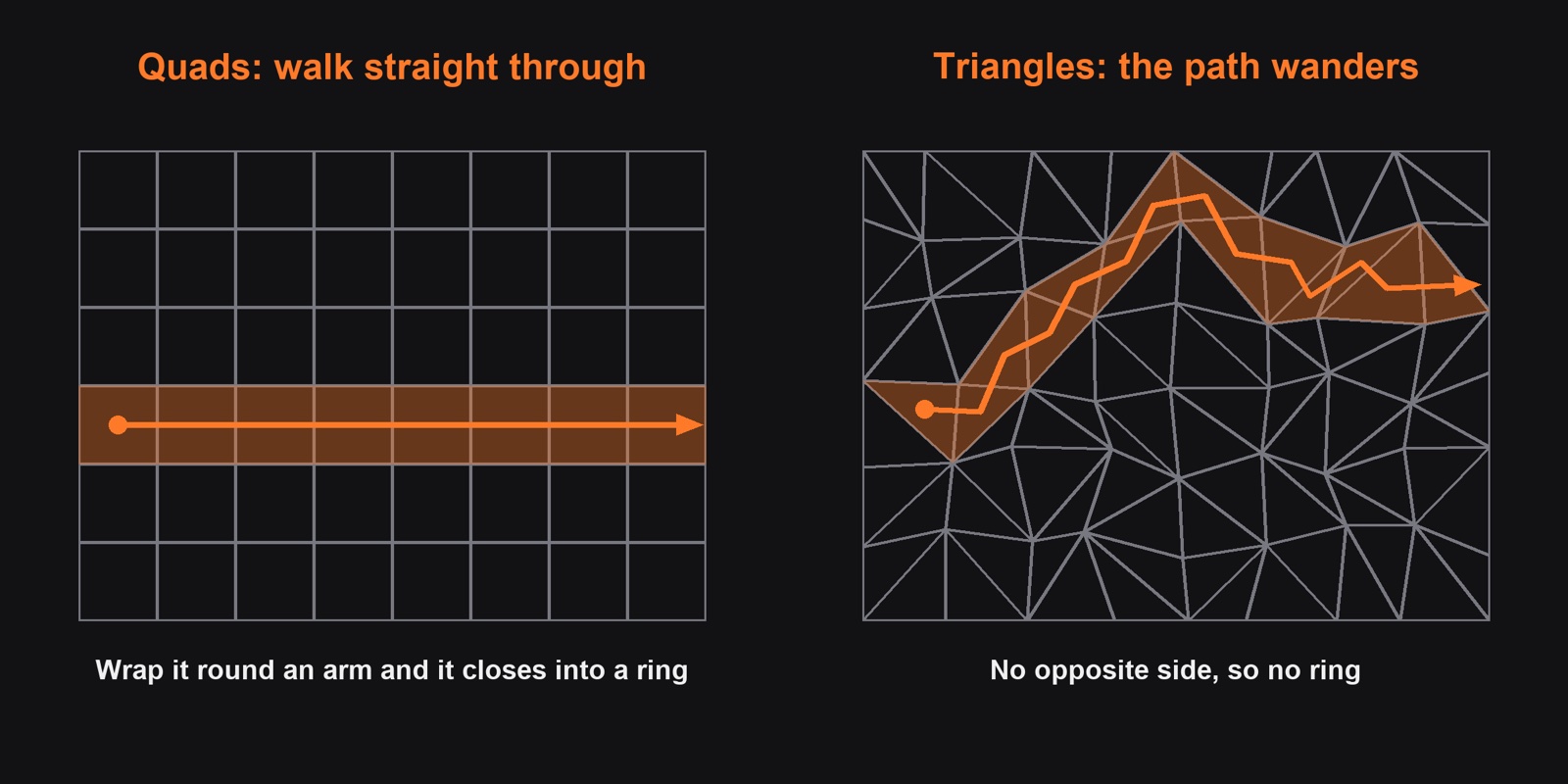
Here's why. A quad has an opposite side. Walk into one, straight out the other side, into the next, and keep going. Go far enough around a shape and you end up back where you started, having gone round it in a ring.
A triangle has no opposite side, only a corner. Walk through triangles and your path wanders off.
This matters because we need nice even rings on a mesh to be able to animate it.
Loops, built up in three steps
- Take one quad. Call its corners A, B, C and D. The top side, AB, is opposite the bottom side, DC.
- Line up more quads, each one sharing a side with the next. You get a ladder. All the top sides join up into one long rail, and all the bottom sides make a second rail.
- Wrap the ladder round an arm until the ends meet. Each rail is now a ring.
That ring is an edge loop: a line of edges that runs around a part and joins up with itself. Think sweater cuff, or the bands on a garden hose. It doesn't need to be a perfect circle. It just has to wrap round and close.
The ladder itself, the strip of quads between two edge loops, is a face loop. Think of it as a ribbon.
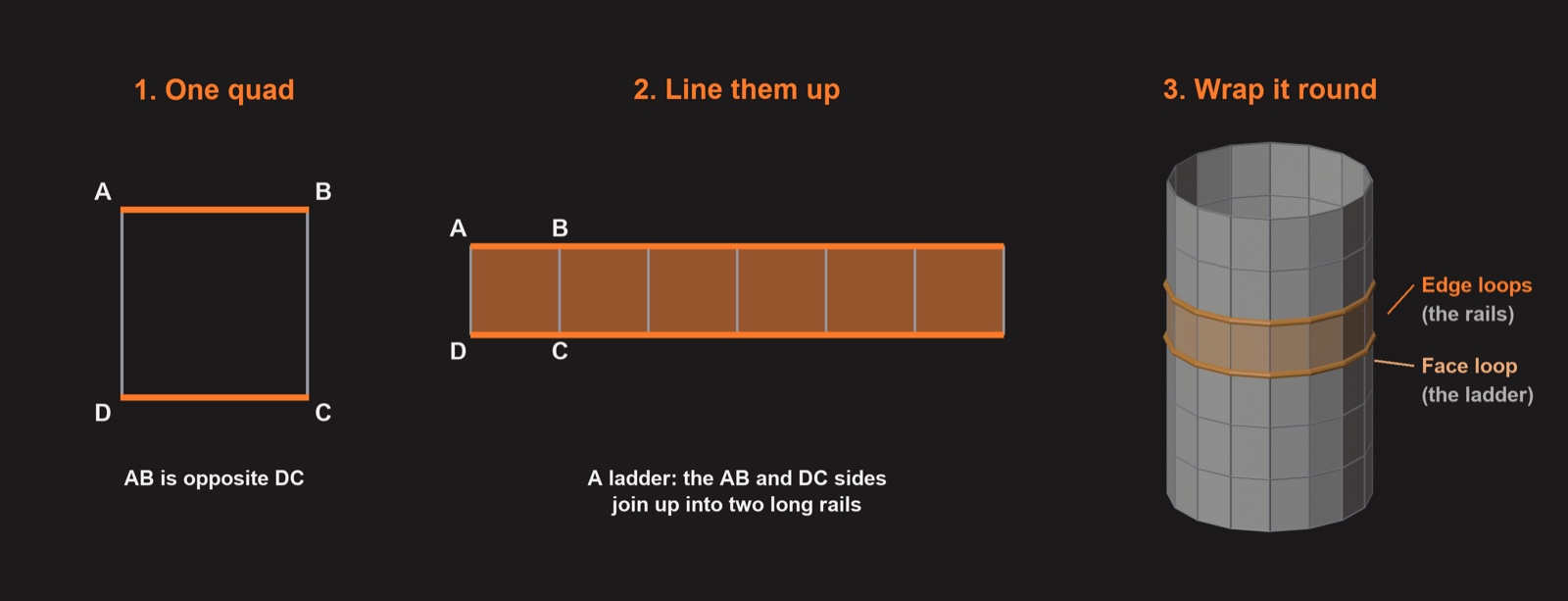
A clean quad mesh is just lots of these: rings around the arm, and lines running along it.
Why rings bend well
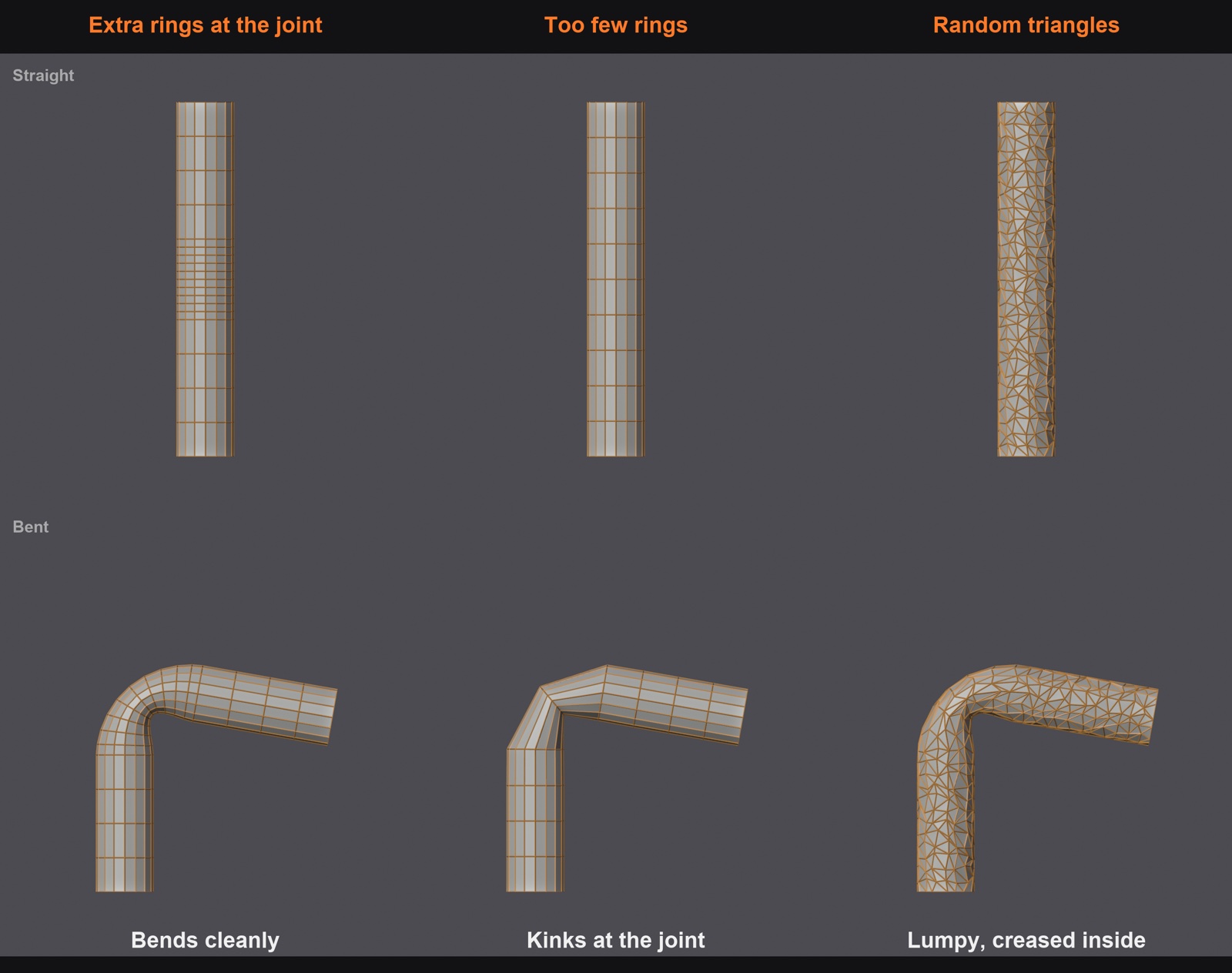
When a character moves, its mesh has to stretch and squash. 3D people call that deforming. Bend an arm and the rings on the inside squash together, while the ones on the outside spread apart. Like an accordion, or the ridges on a bendy straw.
A good elbow has extra rings bunched at the joint. Bend it and the outside stretches smoothly, like cloth pulled tight, while the inside folds neatly. Too few rings and it kinks like a drinking straw. Random triangles go lumpy and crease on the inside. Now think of this for every single bendy or stretchy bit.
A few honest notes
- Mostly quads, not all. Artists use a few triangles where loops merge, hidden where nothing bends.
- No n-gons. Faces with five or more sides are avoided. They bend and smooth unpredictably.
- The graphics card only draws triangles. Every quad gets split in two before it's drawn. Quads are for the artist and the animator, not the screen.
- Loops follow muscles: around the eyes and mouth, shoulders, elbows, knees, hips. Detail goes where it's needed.
- Things that don't move don't need any of this. A crate or a statue can be triangles all the way. This is why the environment assets (props and scenery) you can make with AssetFurnace are awesome to just drop into your game.
So a "game-ready" character, at least one that bends, needs loops where it bends. The rest can be messy.
Who cares about topology?
Different jobs care about different things:
- Games: loops where it bends, and as few triangles as you can get away with.
- Film and previs (rough versions of film scenes, made before the real shoot): subdivision. The software splits every quad into four smaller ones and rounds them off, so the surface gets smoother. That only works cleanly on quads, which is a big reason film artists insist on them.
- Simulation (robots, physics, digital twins): loops matter less. What counts is a watertight mesh, meaning closed with no holes, plus a simple invisible collision mesh. That's a rough stand-in shape the physics engine uses instead of the detailed one, because it's much faster to check.
Where image-to-3D is today
This is currently the biggest bottleneck with the output of open-source image-to-3D models like Pixal3D, Hunyuan3D and TRELLIS.2. They make beautiful shapes, but the triangles follow no plan, so there are no rings at the elbows, knees or face.
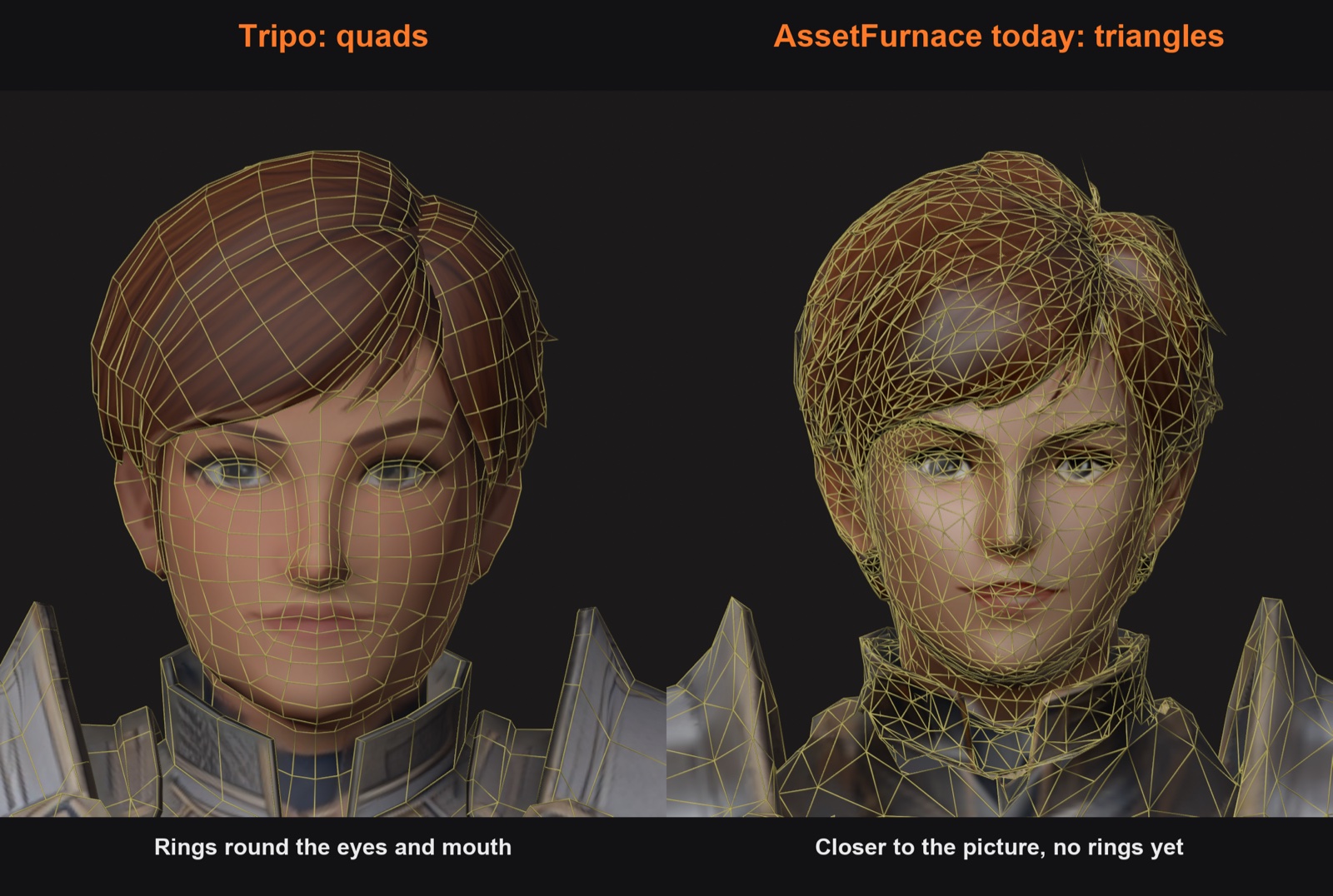
Tripo, Meshy and the other cloud tools have partly solved this with their Smart Topology and Smart Mesh features. Here's the same character from Tripo and from AssetFurnace today. Tripo's face has proper rings round the eyes and mouth. Ours sticks closer to the original picture, but it's still triangles with no rings.
That gap is where we at AssetFurnace are putting in a tonne of time. The goal: free, open-source image to 3D on your own computer, with topology good enough that game devs and artists can drop a rigged character (one with a skeleton, so it can move) straight into their scene and get decent results when it animates.
To sum up
A 3D mesh is nothing but a net of triangles shaped to give you the object you want. How those triangles join up, its topology, decides how naturally it bends when it moves. And that matters whether you're animating a character in a game, a film scene or a simulation.
What's next
Part 3: Having our cake and eating it. How to keep a low triangle count and still have a model that looks good.
Want to try it yourself? AssetFurnace is free and open source on GitHub, and the step-by-step guide takes you from one picture to a rigged, animated character.
If this helped, share it with someone who's getting into 3D, or tell me what you'd like covered next on X. And if you like where AssetFurnace is going, a star on GitHub goes a long way.